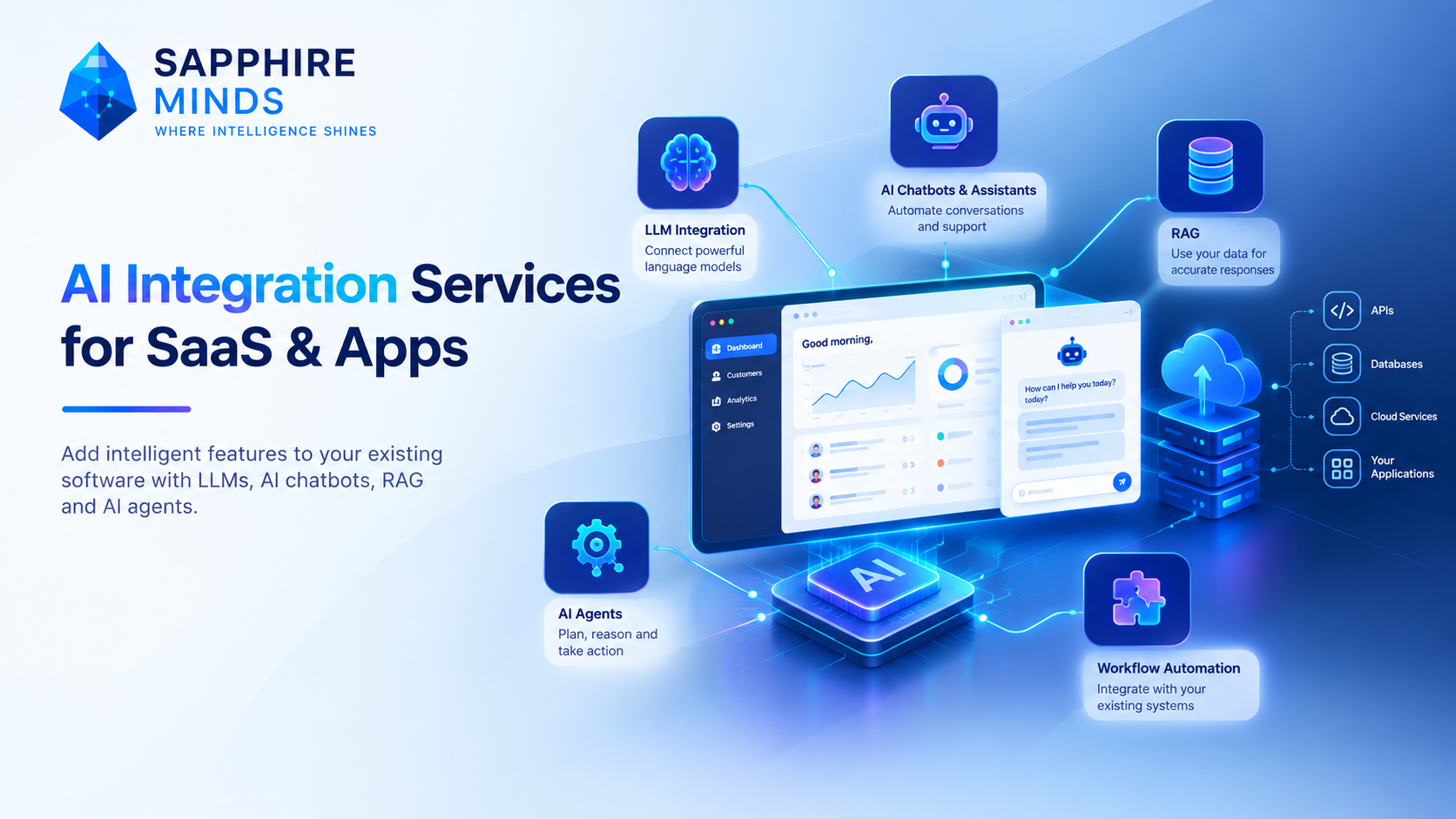
You don't always need to build a new AI platform from scratch. Depending on your existing architecture and objectives, a focused integration may deliver the functionality you need with less unnecessary disruption. If you are planning a new AI product instead, see our AI development services.
AI capabilities we can integrate
LLM API Integration
Connect suitable large language models to your application for tasks such as summarization, text generation, structured information extraction and conversational experiences. Our complete guide to LLM integration and our walkthrough on integrating ChatGPT into a SaaS product cover the basics.
AI Chatbots and Assistants
Add a conversational interface that helps users access information, complete supported tasks or navigate your application.
RAG and Knowledge Search
Connect an AI assistant to relevant company documents or knowledge sources using retrieval-augmented generation. Design considerations include document processing, permissions, retrieval quality and evaluation. See how to build a RAG chatbot for more detail.
AI Agents and Tool Use
Build controlled workflows in which an AI model can select from approved tools and perform defined actions. Sensitive or irreversible actions may require validation or human approval.
Document Processing
Explore AI-assisted extraction, classification, summarization and routing of business documents, with checks appropriate to the accuracy requirements.
Workflow Automation
Connect AI capabilities to existing systems and business processes where the task can be automated safely and reliably.
How we integrate AI into an existing product
1. Assess your application
Review the existing architecture, APIs, data sources, security requirements and target user experience.
2. Identify a useful AI use case
Prioritize a problem that can be evaluated against clear criteria rather than adding AI purely for novelty.
3. Choose the right implementation
Determine whether the feature needs an LLM API, RAG, an AI agent, conventional automation or a combination of approaches.
4. Integrate and evaluate
Implement the feature and test representative inputs, output quality, failure cases, latency and usage costs.
5. Prepare for production
Address authentication, permissions, data handling, monitoring, fallback behavior and other requirements relevant to the application.
Important considerations for AI integration
A successful integration must fit your existing software and operational model. Depending on the project, we consider:
- API and database compatibility
- Model selection and cost
- Privacy and data retention
- User permissions
- Response quality and evaluation
- Rate limits and latency
- Logging and monitoring
- Fallbacks when the model fails
- Human review for higher-risk workflows
If your team needs ongoing AI engineering support, you can also discuss development resources with us.
Frequently asked questions
Can you add AI to my existing SaaS product?
Yes. We can assess your current product and identify suitable integration opportunities based on the architecture and requirements.
Do I need to train my own AI model?
Not necessarily. Many use cases can be addressed with existing models and appropriate prompting, retrieval or tool integration. Custom training should be evaluated against the specific requirements and available data.
What is the difference between RAG and fine-tuning?
RAG retrieves relevant information at query time to support responses. Fine-tuning changes model behavior through additional training. The right choice depends on the problem, data, evaluation needs and available resources.
How much does AI integration cost?
Cost depends on the use case, number of integrations, data preparation, model requirements and production safeguards. Use our AI Project Cost Estimator for a preliminary estimate.