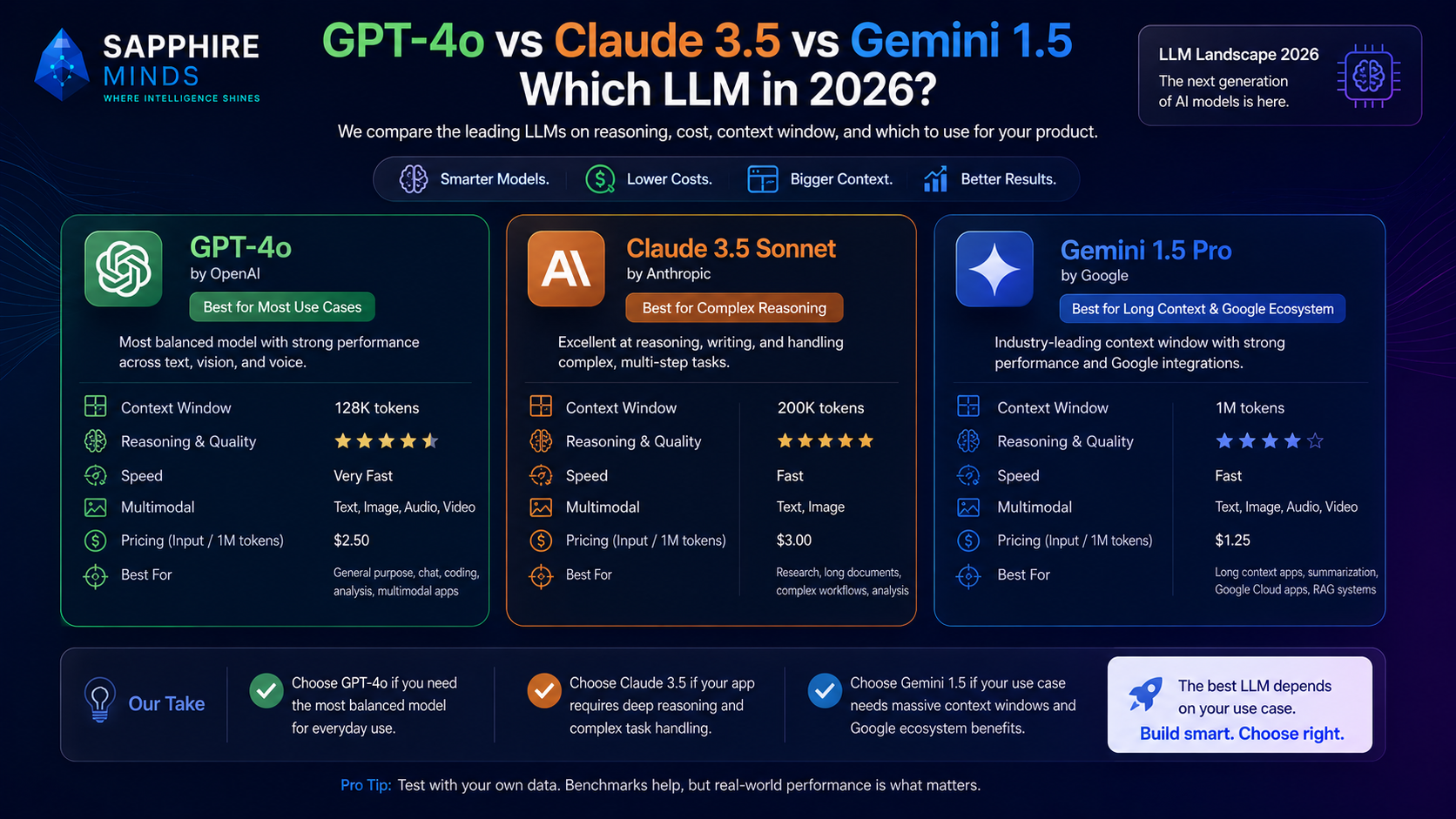
Choosing the right LLM for your product in 2026 matters more than it did in 2023 — the models have diverged meaningfully in capability, pricing, and optimal use cases.
Quick summary:
- GPT-4o — best all-rounder, strongest reasoning, largest ecosystem
- Claude 3.5 Sonnet — best for long documents, writing quality, and instruction following
- Gemini 1.5 Pro — best for very long context (1M tokens) and multimodal inputs
Here's the full breakdown.
Reasoning and intelligence
GPT-4o: Still the benchmark for complex multi-step reasoning. Coding tasks, mathematical problems, and logical analysis consistently rate highest. OpenAI's o1 and o3 models have pushed reasoning further for specific use cases.
Claude 3.5 Sonnet: Close to GPT-4o on most reasoning benchmarks and often considered superior for nuanced writing tasks, instruction following, and avoiding "yes-man" responses. Anthropic's Constitutional AI training makes Claude notably better at refusing edge-case instructions gracefully.
Gemini 1.5 Pro: Strong but generally rated below GPT-4o and Claude on pure reasoning tasks. Gemini's strength is elsewhere.
Winner for complex reasoning: GPT-4o and Claude 3.5 are close; Gemini trails slightly.
Context window
| Model | Context window | Practical implication |
|---|---|---|
| GPT-4o | 128,000 tokens | ~96,000 words — fits most long documents |
| Claude 3.5 Sonnet | 200,000 tokens | ~150,000 words — full books, large codebases |
| Gemini 1.5 Pro | 1,000,000 tokens | ~750,000 words — entire codebases, hundreds of docs |
For document-heavy RAG systems: Claude or Gemini. If you're processing entire contracts, research papers, or code repositories in a single call, context window matters.
For most SaaS features: GPT-4o's 128K window is more than sufficient.
Winner for context: Gemini 1.5 Pro at 1M tokens is in a different category.
Pricing (June 2026)
| Model | Input | Output |
|---|---|---|
| GPT-4o | $2.50 / 1M tokens | $10.00 / 1M tokens |
| GPT-4o mini | $0.15 / 1M tokens | $0.60 / 1M tokens |
| Claude 3.5 Sonnet | $3.00 / 1M tokens | $15.00 / 1M tokens |
| Claude 3 Haiku | $0.25 / 1M tokens | $1.25 / 1M tokens |
| Gemini 1.5 Pro | $1.25 / 1M tokens | $5.00 / 1M tokens |
| Gemini 1.5 Flash | $0.075 / 1M tokens | $0.30 / 1M tokens |
For cost-sensitive high-volume applications: Gemini 1.5 Flash or GPT-4o mini. For quality-sensitive applications: GPT-4o or Claude 3.5 Sonnet. Best value in the mid-tier: Gemini 1.5 Pro at $1.25/$5.00 is notably cheaper than GPT-4o and Claude 3.5.
Coding
GPT-4o remains the strongest coding model among the three for code generation, debugging, and code explanation. OpenAI's deep integration with the developer ecosystem (GitHub Copilot uses GPT models) reflects this.
Claude 3.5 Sonnet is close and many developers prefer its explanations — more verbose, better structured. For code review and explaining existing code, Claude is excellent.
Gemini 1.5 Pro is notably good at repository-level code understanding given its 1M context window — you can feed an entire codebase in a single call.
Which to use for your SaaS product
General-purpose AI features (chatbots, summarisation, generation): Start with GPT-4o mini for cost efficiency. Use GPT-4o for higher-quality outputs.
Document processing and analysis: Claude 3.5 Sonnet for medium-length documents (up to 150K tokens). Gemini 1.5 Pro for very large documents or entire repositories.
RAG chatbots: GPT-4o mini for generation + OpenAI text-embedding-3-small for embeddings is the most common and well-tested combination.
AI writing features: Claude 3.5 Sonnet. Its output quality for structured writing — emails, summaries, professional documents — is consistently rated highest.
Cost-optimised high-volume processing: Gemini 1.5 Flash is the cheapest capable model. GPT-4o mini is a close second.
The practical recommendation for 2026
Default stack for most SaaS AI features:
- Primary: GPT-4o mini (cost efficiency) with GPT-4o available for complex tasks
- Abstract your LLM calls so you can swap models without rewriting
- Test Claude 3.5 Sonnet for writing-heavy features — often worth the premium
The key principle: Don't commit to a single provider. Build your LLM integration behind an abstraction layer so you can route different tasks to the best model for each.
At Sapphire Minds we build LLM-agnostic integrations that can route to GPT-4o, Claude, or Gemini based on task type and cost constraints.
Talk to us about your LLM architecture →
Related: What is LLM Integration? · How to Build a RAG Chatbot · LangChain vs LlamaIndex 2026