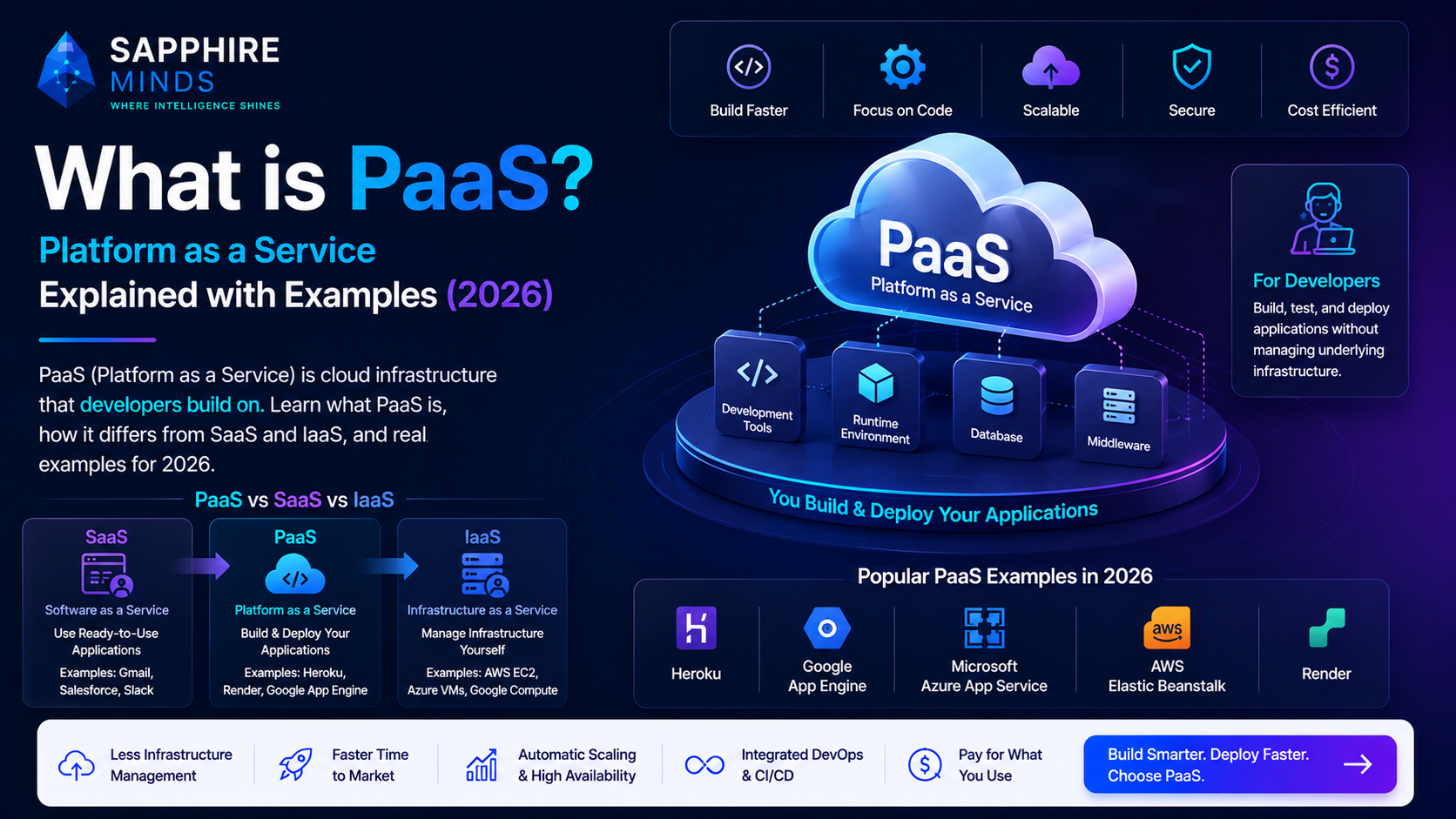
PaaS (Platform as a Service) is a cloud computing model that provides developers with the infrastructure, runtime, and tools they need to build, deploy, and run applications — without managing the underlying servers, operating systems, or hardware.
In simple terms: with PaaS, you write the code. The platform handles everything else.
PaaS vs SaaS vs IaaS
The three cloud service models are best understood through what they ask you to manage:
| IaaS | PaaS | SaaS | |
|---|---|---|---|
| Hardware | Provider | Provider | Provider |
| Virtualisation | Provider | Provider | Provider |
| Operating system | You | Provider | Provider |
| Runtime | You | Provider | Provider |
| Middleware | You | Provider | Provider |
| Your application | You | You | Provider |
| Your data | You | You | Provider |
IaaS (Infrastructure as a Service): Raw computing resources — virtual machines, storage, networking. You manage everything above the hardware. Examples: AWS EC2, Google Compute Engine, Azure Virtual Machines.
PaaS (Platform as a Service): The runtime and infrastructure are managed. You focus on writing application code. Examples: Heroku, Vercel, Railway, Google App Engine.
SaaS (Software as a Service): The complete application is delivered to you. You use it; the vendor manages everything. Examples: Salesforce, Slack, Notion, GitHub.
Real-world PaaS examples in 2026
Developer-focused PaaS:
- Vercel — deploys Next.js and React applications automatically from GitHub. You push code; Vercel handles build, CDN, SSL, scaling.
- Railway — runs Node.js, Python, and database applications. Connect a GitHub repo; Railway provisions the server, manages deployments, and auto-scales.
- Render — similar to Railway. Web services, databases, and cron jobs managed automatically.
- Heroku — the original developer PaaS. Slightly more expensive than newer alternatives but with the most mature ecosystem.
Database PaaS:
- Supabase — managed PostgreSQL with auto-generated APIs, authentication, and real-time subscriptions. You define your schema; Supabase handles the Postgres infrastructure.
- PlanetScale — managed MySQL with branching workflows for schema changes.
- MongoDB Atlas — managed MongoDB with global clusters, backups, and monitoring.
AI/ML PaaS:
- AWS SageMaker — managed machine learning platform for training, deploying, and monitoring ML models.
- Google Vertex AI — Google's managed ML platform, particularly strong for Gemini and Google-developed models.
- Replicate — run open-source ML models via API. You call an API; Replicate handles the GPU infrastructure.
Why businesses use PaaS
Speed: A developer can deploy a production-ready application on Vercel or Railway in minutes. The equivalent setup on raw AWS EC2 (setting up the server, configuring Nginx, SSL, deployment pipelines) takes days.
Reduced ops burden: PaaS platforms handle patching, security updates, scaling, and uptime. Engineering time goes to building product features, not managing infrastructure.
Cost at small scale: For early-stage products, PaaS is almost always cheaper than IaaS when you factor in the engineer time required to manage raw infrastructure.
When PaaS makes sense vs IaaS
Choose PaaS when:
- You're early-stage and want to move fast
- Your team doesn't have dedicated DevOps engineers
- Your workload fits standard patterns (web APIs, databases, scheduled jobs)
- You want automatic scaling without manual configuration
Choose IaaS when:
- You need specific infrastructure configurations PaaS doesn't support
- Your workload is unusual (custom networking, specialised hardware)
- Cost optimisation at large scale justifies the operational overhead
- Compliance requirements require specific infrastructure controls
For most SaaS startups: PaaS to launch, IaaS as you scale beyond what PaaS handles cost-effectively (typically $50,000+/month in infrastructure spend).
Building a PaaS product
If you're building a product that other developers build on — an API platform, a developer tool, or infrastructure-as-a-product — that's also called PaaS from a business model perspective.
Sapphire Minds specialises in building both PaaS-type products (API platforms, developer tools) and SaaS products. The architectural requirements differ significantly — PaaS products need API-first design, usage metering, developer portals, and SDK generation from day one.
Discuss building your platform →
Related: SaaS vs PaaS: Which Should You Build? · How to Build a SaaS MVP in 30 Days