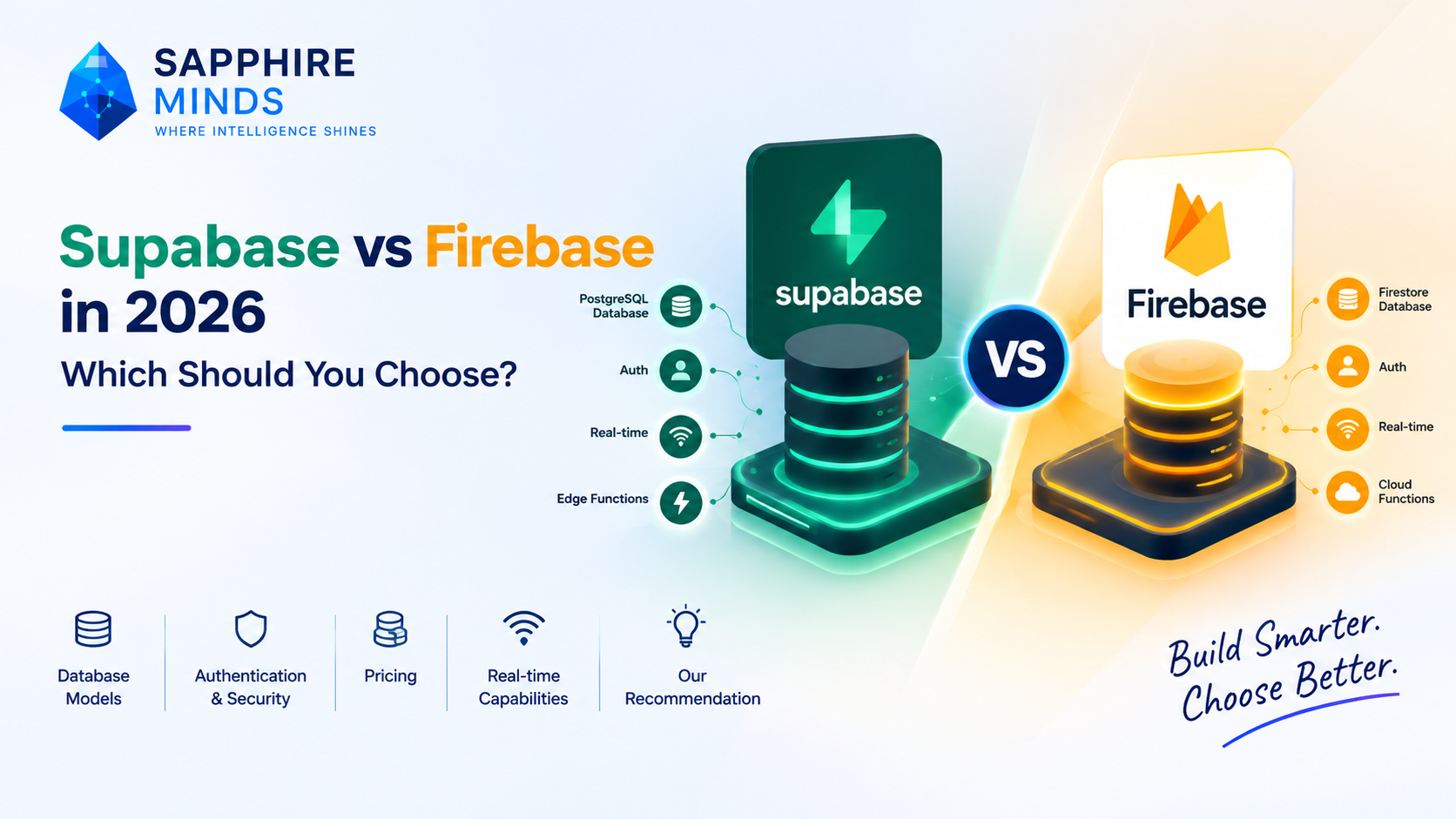
The short answer: Supabase for most new projects in 2026. Firebase still wins for specific use cases — real-time apps, mobile-first products with Google ecosystem dependency, and teams that need offline sync. Here's the full comparison.
What each platform is
Firebase is Google's app development platform. It bundles a NoSQL real-time database (Firestore), authentication, hosting, cloud functions, analytics, and crash reporting. It's been around since 2011, acquired by Google in 2014, and has a massive ecosystem.
Supabase is an open-source Firebase alternative built on PostgreSQL. It provides a hosted Postgres database, auto-generated REST and GraphQL APIs, authentication, file storage, edge functions, and real-time subscriptions. Founded in 2020, it has grown rapidly and is now one of the most popular developer tools in the PostgreSQL ecosystem.
Database model
Firebase (Firestore): NoSQL document database. Data is stored in collections of JSON-like documents. No schema required — you define structure in code. Scales horizontally without limits. Excellent for real-time syncing across clients.
The downside: querying is limited. No joins. No complex aggregations. Compound queries require composite indexes set up in advance. If your data is relational (users have orders, orders have items), you'll work around these limits constantly.
Supabase (PostgreSQL): Relational database. Full SQL — joins, views, triggers, stored procedures, full-text search, JSONB columns, Row Level Security. If you know SQL, you're productive immediately. If your data has relationships (and most SaaS data does), PostgreSQL's model fits naturally.
The downside: relational databases require upfront schema design. NoSQL's flexibility isn't there.
Winner for most SaaS products: Supabase. Relational data is the norm for SaaS — users, organisations, subscriptions, billing records, audit logs. PostgreSQL handles all of it cleanly.
Authentication
Firebase Auth: Mature, battle-tested, supports email/password, phone, Google, Apple, GitHub, Facebook, SAML, and OpenID Connect. The SDKs are excellent and it works seamlessly with other Firebase services. Google Sign-In is trivially easy.
Supabase Auth: Built on GoTrue (originally from Netlify). Supports email/password, magic links, OAuth providers (Google, GitHub, Apple, etc.), phone, and SAML for enterprise. Row Level Security integrates directly with auth — policies reference auth.uid() directly in SQL. Very clean for role-based access control in PostgreSQL.
Winner: Roughly equal for standard use cases. Firebase slightly ahead on mobile SDKs. Supabase ahead for PostgreSQL-integrated access control.
Pricing
Tier | Firebase | Supabase |
|---|---|---|
Free | Spark plan — generous limits, no credit card | 2 free projects, 500MB DB, 1GB file storage |
Paid (starter) | Pay-as-you-go — costs vary widely with usage | $25/month — 8GB DB, 100GB bandwidth |
Predictability | Variable — bills can spike unexpectedly | Fixed monthly — easier to budget |
Firebase's PAYG model can produce surprise bills if usage spikes. Supabase's flat monthly pricing is more predictable for early-stage startups.
Real-time capabilities
Firebase: Real-time is its original core feature. Firestore's onSnapshot listeners push changes to connected clients instantly. This is Firebase's clearest advantage — it was built from the ground up for real-time sync.
Supabase: Real-time subscriptions via PostgreSQL's logical replication. Works well, though Firebase's real-time is more battle-tested at very high concurrency. Supabase's Realtime v2 (2026) has closed the gap significantly.
Winner for real-time: Firebase, especially for very high-frequency updates or mobile offline sync.
When to choose Supabase
Your data is relational (most SaaS products)
You want SQL and the full PostgreSQL ecosystem
You need complex queries, joins, or aggregations
Predictable, flat monthly pricing matters
You want to self-host later (Supabase is open source)
You're building with Next.js, Node.js, or Python
When to choose Firebase
Real-time sync is core to your product (collaborative apps, live dashboards)
You're building mobile-first with Flutter or React Native and need offline sync
Your team already knows Firebase and switching has no clear benefit
You need deep Google Cloud integration
At Sapphire Minds, we default to Supabase for new SaaS products. Its PostgreSQL foundation, clean auth integration, and predictable pricing make it the right choice for most of what we build. Talk to us about your project →