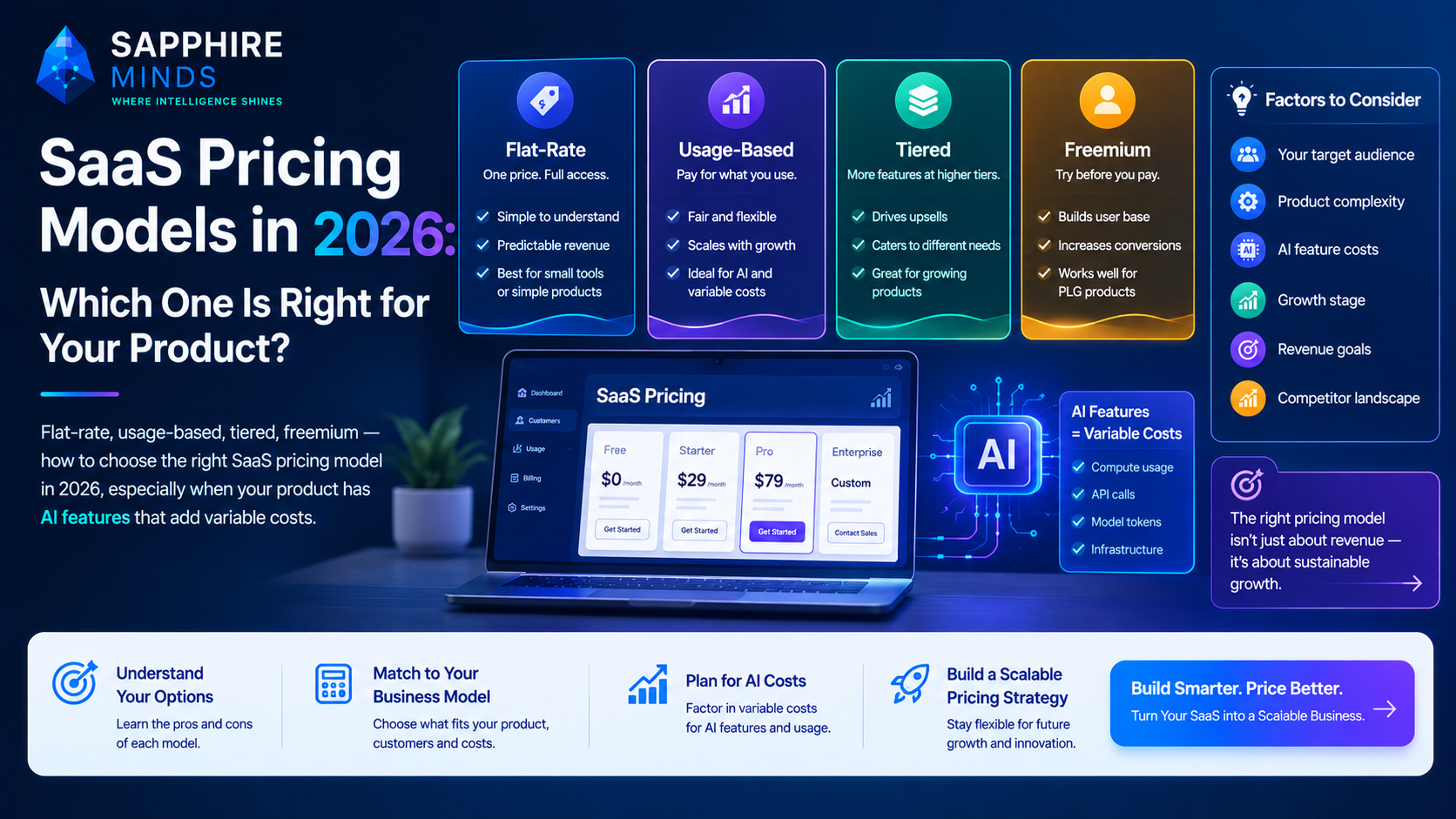
Choosing a pricing model is one of the most consequential decisions you'll make when building a SaaS product — and in 2026, it's more complex than it used to be. AI features have reintroduced variable costs into software economics, forcing founders to rethink the simple "charge a flat monthly fee" approach.
Why pricing models matter more than you think
Your pricing model determines who buys your product, how they use it, and how you grow. The wrong model leads to customers who churn when they hit unexpected limits, revenue that doesn't scale with value delivered, and margins that collapse at scale because you're absorbing AI infrastructure costs.
According to Gartner's 2026 forecast, 70% of businesses now prefer usage-based pricing over per-seat models — driven largely by AI-powered SaaS products where value delivery is variable by nature.
The 6 SaaS pricing models
Model 1 — Flat-rate: One fixed monthly price. Simple to sell. Best for narrow-scope products with well-defined users. Worst for products with AI components where each user interaction has a real API cost.
Model 2 — Per-seat / per-user: Charge per user who has access. The most common B2B SaaS model historically. Losing ground in 2026 — OpenView's benchmark shows a 15% decline in adoption. Customers hate paying for seats that barely log in.
Model 3 — Tiered pricing (Good/Better/Best): Multiple packages at different price points. The dominant model in 2026. Standard structure:
Tier | Target | Price range |
|---|---|---|
Starter | Solopreneurs, small teams | $29–$99/month |
Pro | Growing teams, power users | $99–$299/month |
Enterprise | Large orgs, compliance needs | Custom / $500+ |
Model 4 — Usage-based / pay-as-you-go: Customers pay for what they use. Growing fast because AI-native products have real marginal costs. Challenge: revenue becomes unpredictable and customers struggle to budget.
Model 5 — Freemium: Free basic tier, paid upgrade for advanced features. Typical conversion rate: 2–5%. For most B2B SaaS, a free trial (14–30 days, full features, no credit card) converts better than a permanent free tier.
Model 6 — Hybrid (the 2026 standard for AI products): A subscription base that includes a usage allowance, with overage billing beyond the limit.
Plan | Monthly fee | Included queries | Overage |
|---|---|---|---|
Starter | $49 | 500 queries | $0.05/query |
Pro | $149 | 2,000 queries | $0.04/query |
Scale | $399 | 8,000 queries | $0.03/query |
How to choose your model
Ask three questions: 1) What is my marginal cost per user/interaction? If near-zero → flat-rate or tiered. If real and variable → hybrid or usage-based. 2) Does value scale with users or usage? 3) Who is my buyer — SMB or enterprise?
The AI pricing trap to avoid
Never offer "unlimited AI" inside a flat subscription without modelling your unit economics first. A heavy user generating 50M tokens/month at GPT-4o mini pricing costs $7.50 in API alone — possibly more than their subscription fee.