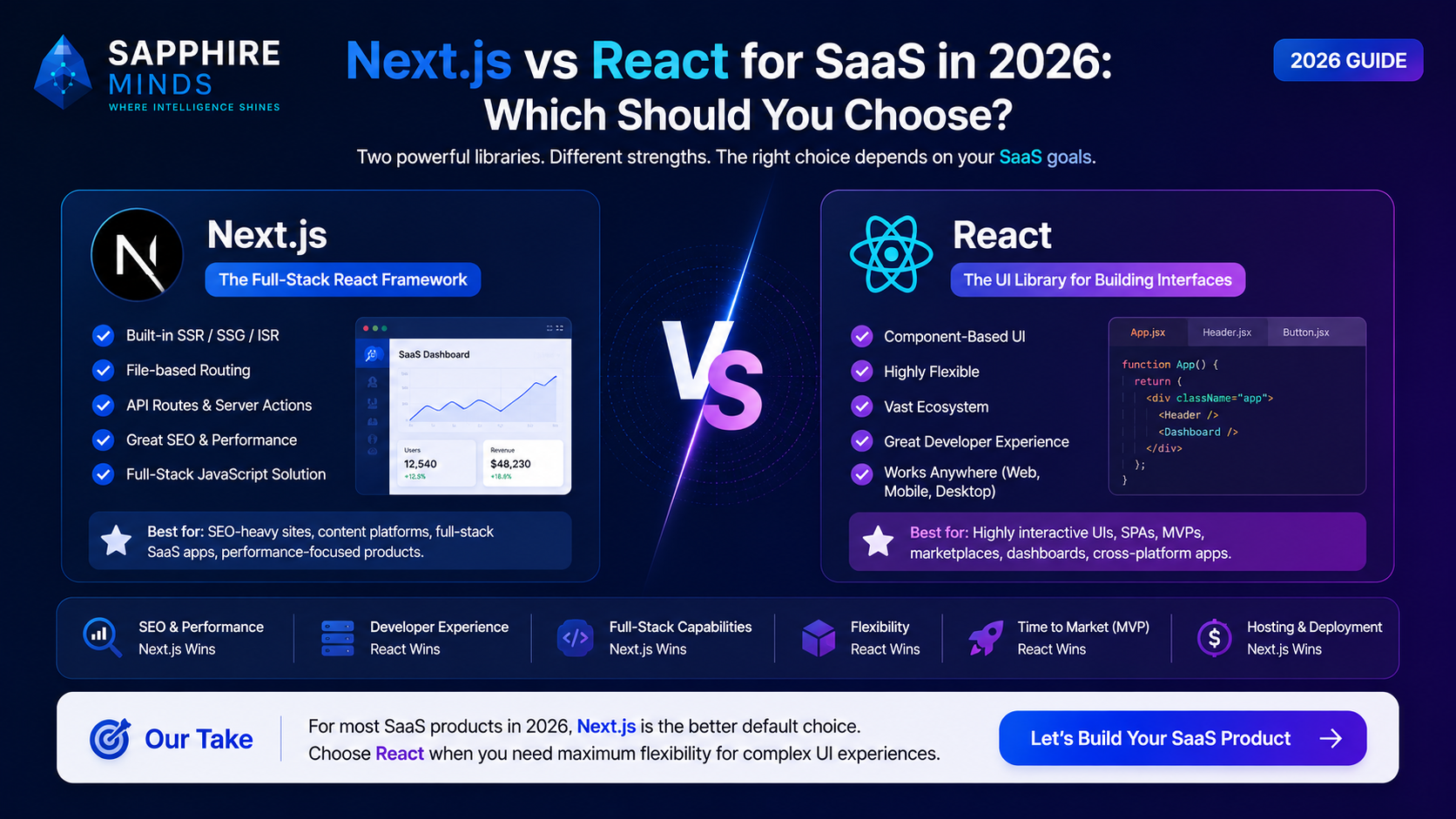
The short answer: For most SaaS products in 2026, use Next.js. It gives you React plus server-side rendering, file-based routing, API routes, and better SEO out of the box — without meaningful downsides for SaaS use cases.
Here's when that rule breaks and why.
What's the actual difference?
React is a UI library. It renders components to the DOM, manages state, and handles events. That's it. Routing, data fetching, server rendering — React doesn't do these by default.
Next.js is a framework built on React that adds:
Server-Side Rendering (SSR) and Static Site Generation (SSG)
File-based routing (no react-router setup)
API routes (backend endpoints in the same repo)
Image optimisation, font optimisation, and bundle splitting out of the box
App Router for advanced layouts and streaming (since Next.js 13)
In 2026, when developers say "React" for a new project, they usually mean Create React App (CRA) or Vite — both are client-side only, with no SSR.
SEO — Next.js wins decisively
This is the biggest practical difference for SaaS products.
React (CRA/Vite): Sends an empty HTML shell to the browser. JavaScript loads and renders the content client-side. Googlebot can execute JavaScript, but it takes 2–5 seconds longer and is less reliable for indexing than pre-rendered HTML.
Next.js: Sends pre-rendered HTML with actual content. Googlebot reads it immediately. Page metadata is in the HTML. Content is indexable on first crawl.
For a SaaS product's marketing pages, blog, and public-facing content, this difference is significant. We've seen this exact issue cause indexing failures on pure React SaaS sites — Googlebot unable to read content because JavaScript blocked by robots.txt or rendering timeouts.
Performance — Next.js has the edge
Next.js's automatic code splitting, image optimisation, and font loading improvements deliver measurably better Core Web Vitals than equivalent React apps. The App Router's streaming and Suspense support means users see content faster.
For a SaaS dashboard (where users are already logged in and SEO doesn't apply), the performance difference matters less. For marketing pages and blog content, it matters considerably.
Developer experience
React (Vite): Faster development server startup than Next.js. Simpler mental model. Fewer concepts to learn. Good for teams that just need a fast UI layer.
Next.js: More to learn initially (App Router, Server Components, Server Actions). But once familiar, the co-location of frontend and backend logic significantly reduces friction. No need for a separate Express server for simple APIs.
When to use Next.js
Your SaaS has public-facing pages (marketing, blog, docs) that need SEO
You want a single repo for frontend and lightweight backend API routes
You're building from scratch in 2026
Your team knows React (Next.js is React — same components, same hooks)
You're deploying to Vercel (zero-config deployment)
Use Next.js for 90% of SaaS products. It's what we default to at Sapphire Minds.
When to use React (Vite/CRA) without Next.js
You're building an internal tool with no public pages
The entire product is behind a login (dashboard-only, no marketing site)
You have an existing separate backend and don't need API routes
Your team has strong React expertise and Next.js adoption would slow the project
Even here, Next.js works fine — but Vite's simpler setup and faster dev server make it a reasonable choice for pure dashboard applications.
The migration reality
We've migrated several React (CRA) applications to Next.js. The main effort:
Replace
react-router-domwith Next.js file-based routingConvert data fetching from
useEffect+fetchtogetServerSidePropsor Server ComponentsUpdate build and deployment configuration
For a typical SaaS application, a migration takes 2–4 weeks depending on complexity. The SEO and performance gains are consistently worth it.
What Sapphire Minds uses
We default to Next.js 14+ with TypeScript for all new SaaS projects. The App Router, Server Components, and Server Actions have matured significantly — the developer experience is excellent and the output is production-ready.
For pure internal dashboards, we sometimes use Vite + React for its faster iteration cycle during development.
Discuss your SaaS architecture with us →