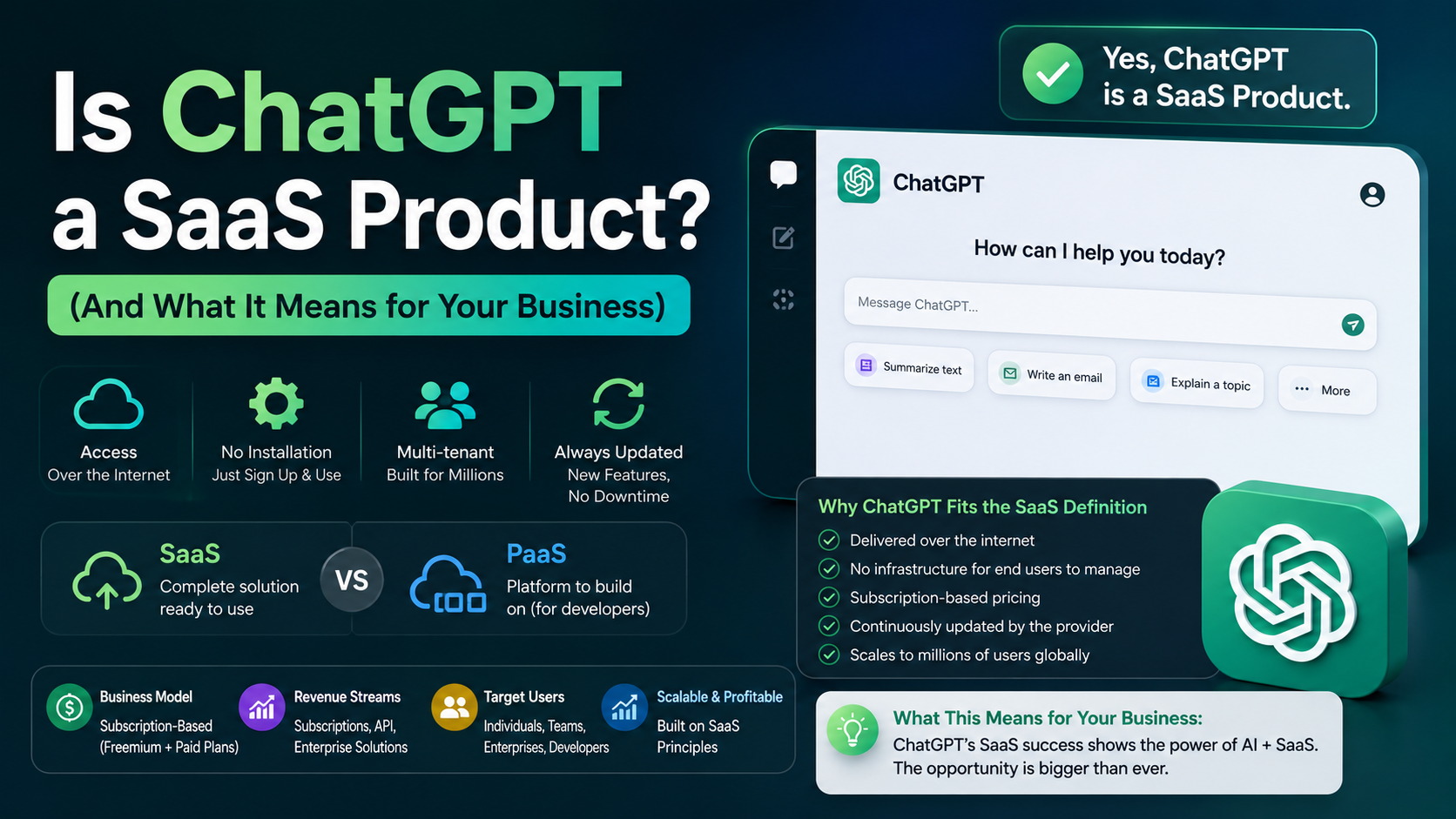
Is ChatGPT a SaaS Product? (Yes — Here's Why It Matters)
If you've searched this question, you're probably trying to understand one of two things: either what SaaS actually means, or whether your AI product idea fits the SaaS model. Either way, the answer is worth understanding properly — because it has real implications for how you build and price your own product. Whether you're asking "is ChatGPT a SaaS", "is ChatGPT considered SaaS", or "is OpenAI SaaS"
The short answer: Yes, ChatGPT is a SaaS product. But it's also more than that — and the distinction matters if you're building your own AI product.
What makes something a SaaS product?
SaaS (Software as a Service) has three defining characteristics:
1. Delivered over the internet — users access it via a browser or app, not a locally installed program.
2. Subscription or usage-based pricing — users pay to access the software, not to own it outright.
3. Hosted and maintained by the provider — the vendor manages the infrastructure, updates, and uptime. The user just uses it.
By all three criteria, ChatGPT qualifies. You access it via chat.openai.com or the mobile app. OpenAI maintains all the servers, models, and infrastructure. And ChatGPT Plus users pay $20/month for access — a classic subscription model.
But ChatGPT is also a PaaS — depending on how you use it
Here's where it gets interesting. OpenAI doesn't just offer ChatGPT as a consumer product. They also offer the OpenAI API — which lets developers call the same underlying models (GPT-4o, GPT-4o mini) from their own applications.
When you use the API, OpenAI becomes a Platform as a Service (PaaS) provider. You're not using their interface — you're building your own product on top of their infrastructure.
This is why OpenAI is often described as both:
SaaS — for ChatGPT.com users who interact directly with the product
PaaS — for developers who build applications using the API
It's the same model as Stripe (payments SaaS + payments API), Twilio (messaging SaaS + messaging API), and Cloudinary (image management SaaS + image API). The underlying capability is the same — what changes is who's consuming it and how.
The ChatGPT business model explained
OpenAI has built a multi-layer business model on top of the same core technology:
Layer 1 — Free tier (ChatGPT free) Users get limited access to GPT-4o mini. This drives adoption, word of mouth, and data. Classic freemium SaaS.
Layer 2 — ChatGPT Plus ($20/month) Users get GPT-4o, image generation (DALL·E), advanced reasoning (o1), and higher usage limits. Pure subscription SaaS.
Layer 3 — ChatGPT Team and Enterprise Per-seat pricing for businesses. Adds admin controls, data privacy, higher limits, and SSO. B2B SaaS at scale.
Layer 4 — OpenAI API (usage-based) Developers pay per token (per word, roughly). No fixed subscription — you pay for what you use. This is the PaaS/infrastructure layer.
Layer 5 — Custom GPTs and GPT Store A marketplace model — similar to Shopify's app store or Salesforce AppExchange. Platform economics.
This layered approach is actually a playbook worth studying if you're building an AI product of your own.
What this means if you're building an AI SaaS product
ChatGPT's success has created a common misconception: that building an AI product means competing with OpenAI. It doesn't. OpenAI is the infrastructure layer — the equivalent of AWS for compute or Stripe for payments.
The most successful AI SaaS products being built right now are using OpenAI (or Anthropic, or Google) as a component, not competing against them. They're solving specific problems for specific users and using LLMs as the engine underneath.
Examples of this pattern:
A legal SaaS that uses GPT-4o to summarise contracts for law firms
A customer support tool that uses Claude to handle tier-1 tickets automatically
A medical documentation tool that uses Whisper (OpenAI's speech model) to transcribe doctor-patient conversations
A sales intelligence tool that uses LLMs to research prospects and draft personalised outreach
None of these compete with ChatGPT. They all use OpenAI's API as infrastructure and build specific, valuable products on top of it.
The three AI SaaS business models worth knowing
If you're thinking about building an AI product, your business model will typically fall into one of these:
Model 1 — AI-powered vertical SaaS A traditional SaaS product in a specific industry, with AI features embedded. You charge a subscription. The AI reduces cost or improves the product — it's not the product itself. Examples: AI-enhanced CRM, AI-powered HR tools, AI-assisted legal software.
Model 2 — AI-native SaaS The AI capability is the core value proposition, not a feature. Users are paying specifically for what the AI does. Examples: Jasper (AI writing), Midjourney (AI image generation), Harvey (AI for lawyers).
Model 3 — API / AI infrastructure You build the AI capability and sell access to it via API. Other developers build products on top of you. This is what OpenAI, Anthropic, and ElevenLabs do. High barrier to entry — requires significant ML expertise and compute.
Most founders should aim for Model 1 or 2. Model 3 requires resources that most startups don't have.
Should you build your AI product as SaaS or charge per usage?
This is one of the most common questions when building AI products — because the underlying cost (API calls) is usage-based, but users often prefer predictable subscription pricing.
The practical answer most AI SaaS companies land on:
Charge a subscription that includes a generous usage allowance, then charge overage above the limit. This gives users predictability while protecting your margins.
Example:
Starter: $49/month → includes 500 AI queries/month
Pro: $149/month → includes 2,000 AI queries/month
Enterprise: Custom → unlimited with SLA
This approach mirrors what most successful AI SaaS companies have converged on in 2026.
Building an AI SaaS product? Here's where to start
The biggest mistake founders make when building AI products is starting with the technology rather than the problem. "We're building a GPT-4-powered X" is not a business. "We're solving Y problem for Z type of company, and AI is how we do it better than anyone else" — that's a business.
If you have a clear problem and a clear user, adding AI to your SaaS product is more achievable than most people think. The OpenAI API is well-documented, the costs are manageable at early scale, and the tooling (LangChain, LlamaIndex, vector databases) has matured significantly.
At Sapphire Minds, we've built AI integrations across multiple SaaS products — from RAG-powered support tools to generative content features to AI-native products built from scratch. If you're figuring out how AI fits into your product, book a call with us OR get an instant AI estimate.