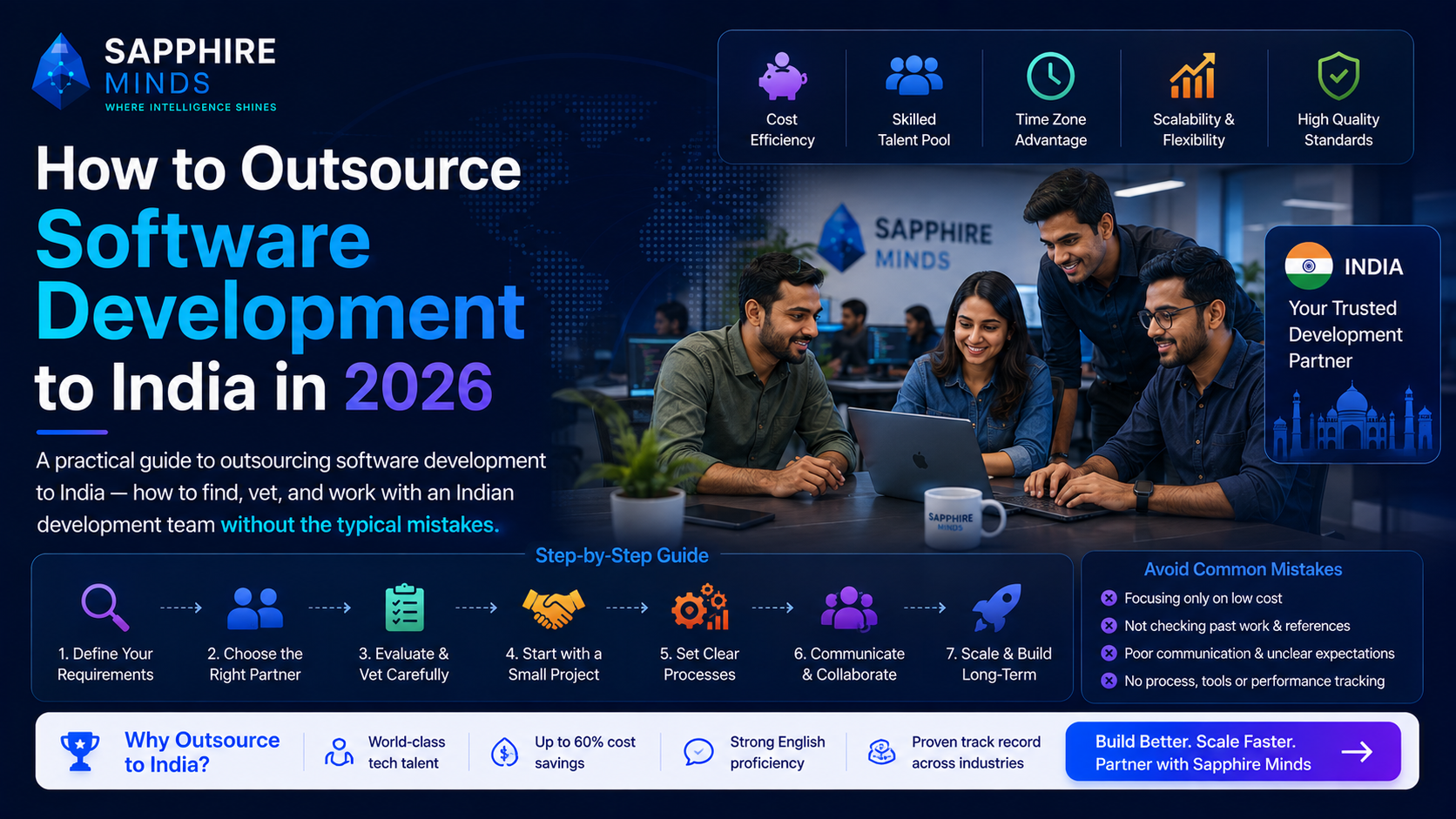
Outsourcing software development to India is one of the highest-leverage decisions a startup or growing company can make — if you do it right. The cost savings are real (typically 60–70% vs. US teams), but the failure rate for poorly structured outsourcing engagements is also real.
This guide covers what actually works, from someone who operates an India-based development company.
Why India specifically in 2026
India's developer ecosystem has matured considerably since the early outsourcing era. The main reasons it remains the dominant offshore destination:
Depth of talent: 4.5 million software developers. Deep expertise in React, Node.js, Python, Flutter, AI/ML, cloud infrastructure, and every major enterprise stack. The quality at the $30–70/hour range is competitive with Western developers at $150–250/hour for most technology categories.
English proficiency: India ranks among the highest non-native English-speaking developer populations globally. Communication friction — the #1 source of outsourcing failures — is lower with Indian teams than with comparable cost markets.
Time zone: IST (UTC+5:30) overlaps meaningfully with European mornings and US afternoons. A 9am IST standup is 3:30am UK time — workable for async. An end-of-day IST demo is morning in the UK, afternoon in the US.
Ecosystem maturity: India's software export industry has operated at scale for 30+ years. The best agencies have developed repeatable processes for remote collaboration, milestone-based delivery, and client communication.
The three outsourcing models
Fixed-price project: You define the scope, the agency quotes a price, work is delivered in milestones. Best for: well-defined MVPs, specific features, projects with clear requirements. Risk: scope changes are expensive.
Dedicated team: Monthly retainer for a team working exclusively on your product. Best for: ongoing product development, startups that iterate based on user feedback. Most flexible model.
Staff augmentation: One or two developers work within your existing team. You manage them directly. Best for: filling specific skill gaps, extending your in-house team's capacity.
How to find a reliable Indian development company
Start with verified directories:
- Clutch.co — client reviews are verified with real contact details. Filter: India, your service type, minimum 4.5 stars, minimum 10 reviews.
- GoodFirms — similar to Clutch, good India coverage, ISO certification data.
- TechBehemoths — strong for niche service categories like LLM integration, Flutter, etc.
What to look at beyond the rating:
- Review recency — are reviews from the last 12 months?
- Review content — do clients describe the working relationship, or just rate 5 stars?
- Portfolio — can you see live products, not just case study PDFs?
How to evaluate before signing
1. Ask for live products, not mockups Any capable agency can show you case study slides. What you want: live URLs you can load, test, and evaluate. If they can't provide these, their "portfolio" may be screen recordings of demos that were never shipped.
2. Talk to past clients directly Ask for 2–3 references and call them. 15 minutes with a past client tells you more than any sales process. Ask: "What went wrong, and how did the agency handle it?"
3. Technical interview the developers Ask to speak directly with the developer who will work on your project before signing. A 30-minute technical call — discussing architecture decisions, asking them to review a piece of code, or explaining a past project — reveals capability and communication style immediately.
4. Paid discovery phase Start with a 1–2 week paid discovery (typically $2,000–$5,000) before committing to full development. The agency produces a technical spec and architecture plan. If the quality is poor, you've spent $3,000 rather than $50,000 finding out.
Structuring the engagement
Milestone-based payments: Never pay more than 20–30% upfront. Tie payments to specific, verifiable deliverables — not calendar dates.
Git access from day one: You should have access to your codebase at all times throughout the project, not just at completion.
Communication cadence: Agree in writing before work starts — daily async updates, weekly video demos, response time expectations (24 hours for normal queries, 4 hours for urgent issues).
Define "done" explicitly: Every milestone needs acceptance criteria. What exactly constitutes completion? What QA tests must pass? Without this, "done" means different things to different people.
Common outsourcing mistakes
Choosing on price: The cheapest quote leads to the highest total cost. A $15,000 build that needs a $30,000 rewrite costs $45,000. The difference in hourly rate between a $25/hour shop and a $50/hour shop on a 3-month project is often $12,000 — less than one iteration of rework.
No IP clause: Verify the contract explicitly states all code, designs, and assets become your property on final payment. Some agencies use proprietary frameworks that create dependency.
Treating it as a hands-off project: The best outsourcing relationships require 3–5 hours per week of client involvement — reviewing work, making decisions, giving feedback. Less involvement leads to more assumptions, which leads to rework.
Why Sapphire Minds
We're an India-based AI-first development company that works with startups and growing businesses globally. We offer fixed-price MVPs, dedicated team models, and staff augmentation across React, Next.js, Node.js, Python, Flutter, React Native, and AI/LLM development.
Book a free project scoping call →
Related: What is a Dedicated Development Team? · How Much Does SaaS Development Cost in 2026?