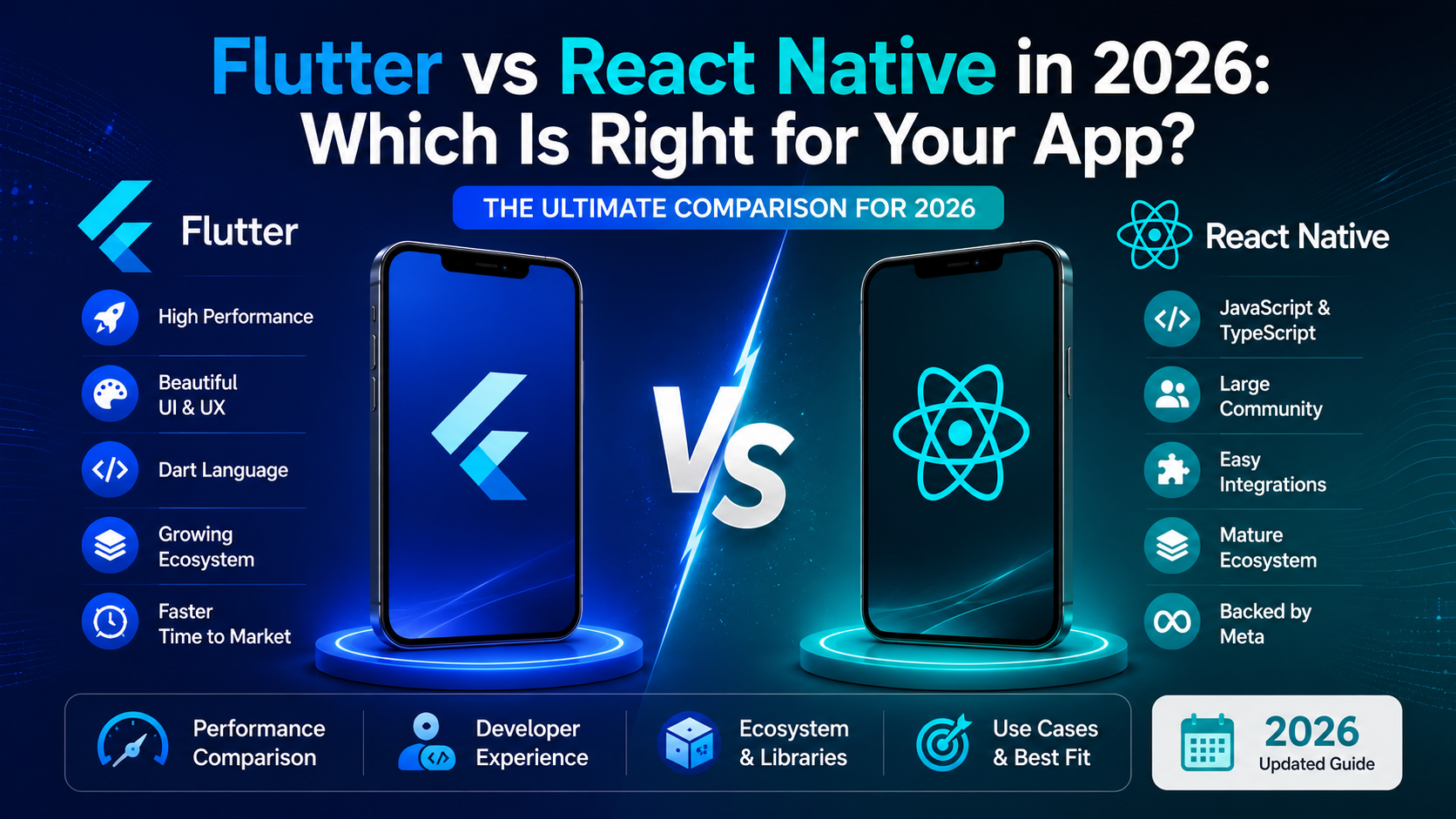
If you're building a cross-platform mobile app, you've almost certainly hit this question: Flutter or React Native? Both are mature, production-proven frameworks backed by major tech companies. Both can get your app on iOS and Android from a single codebase. But they're not interchangeable.
Here's a clear, honest comparison to help you choose.
What is Flutter?
Flutter is Google's open-source UI framework. It uses the Dart programming language and renders everything using its own graphics engine (Skia/Impeller), meaning it doesn't rely on native platform components at all. What you see is what Flutter draws — pixel-perfect, consistent across iOS and Android.
What is React Native?
React Native is Meta's framework for building mobile apps using JavaScript (or TypeScript). Unlike Flutter, React Native renders using native platform components — so a button on iOS looks and behaves like an iOS button, and on Android it looks like an Android button.
Performance
Flutter: Excellent. Because Flutter draws its own UI, there's no "bridge" between JavaScript and native code. Animations are consistently smooth at 60fps or 120fps on supported devices.
React Native: Good, but can be slower for complex UIs. The new architecture (JSI + Fabric), now fully mature in 2026, significantly improved performance and eliminates the old JS bridge bottleneck.
Winner: Flutter for raw performance. React Native with the new architecture is close.
Developer experience
Flutter: Great if your team knows Dart (or is willing to learn). The tooling is excellent — hot reload is fast, the widget library is comprehensive, and the documentation is outstanding.
React Native: Excellent if your team already knows JavaScript or TypeScript. Most web developers can be productive in React Native quickly. The ecosystem of libraries is vast.
Winner: React Native for teams with JS experience. Flutter for greenfield projects where you can choose the stack.
UI consistency vs native feel
Flutter: Pixel-perfect consistency everywhere. Your app looks identical on a Samsung Galaxy and an iPhone 15. Great for custom-branded apps.
React Native: Native components mean the app feels natural on each platform. Some users prefer this. However, cross-platform visual consistency requires more effort.
Winner: Depends on your priority. Brand consistency → Flutter. Native feel → React Native.
Ecosystem and libraries
React Native: Massive ecosystem. Almost every third-party SDK (analytics, payments, maps, advertising) has a React Native wrapper. Many are maintained by the SDK vendors themselves.
Flutter: Rapidly growing, but still smaller. Most major integrations exist, but you may occasionally hit a missing plugin or an unmaintained one.
Winner: React Native for ecosystem maturity.
When to choose Flutter
- You're building a highly custom or brand-driven UI
- Your team is open to Dart or starting fresh
- You need consistent performance on low-end Android devices
- You want to target web and desktop in addition to mobile (Flutter supports all platforms)
When to choose React Native
- Your team already works in JavaScript/TypeScript
- You want maximum library and SDK support
- You're integrating with a React web codebase and want to share logic
- The native platform feel matters to your users
What does Sapphire Minds use?
We use both — and we'll recommend the right one for your project, not the one we're most comfortable with. For most startup MVPs, we lean toward Flutter for its speed and consistency. For teams with React background or complex third-party integrations, React Native is often the better fit.
Want to discuss which is right for your app? Book a free consultation